
If you're an active adult in Leawood — whether you're a weekend athlete, fitness enthusiast, or someone who simply refuses to slow down — you've probably experienced that nagging feeling: something doesn't feel quite right. Maybe your shoulder bothers you during overhead presses. Your knee aches after running. Your lower back tightens up after a long day at the office followed by a workout.
Most people in your shoes head to a general chiropractor expecting a quick fix: crack your back, feel better, go home. Some get temporary relief. Many don't.
Here's the problem: traditional chiropractic treats pain as a standalone issue. But if you're active, your pain is almost never standalone. It's a message from your body that something in your movement system isn't working properly.
That's why active adults throughout Leawood, Prairie Village, and Overland Park are choosing a different approach.
The Active Adult Problem
Active adults face a unique challenge. You're strong enough that minor dysfunction doesn't stop you — it just limits you. You push through it. You work around it. You modify your workout and hope it gets better.
This approach works... until it doesn't.
The truth is that movement dysfunction compounds. If your hip mobility is limited, you'll compensate by rotating your lower spine instead. Your core will tighten to stabilize. Your glutes will stop working. And suddenly, a simple limitation has become a complex compensation pattern that affects your entire kinetic chain.
Now, when pain finally arrives, it's often not in the area that started the problem.
Why Standard Chiropractic Isn't Built for Active Adults
Traditional chiropractic has a fundamental assumption: find the subluxation (joint misalignment), adjust it, and the problem is solved. Historically, there's been little concern with understanding why the joint became misaligned in the first place or what movement patterns might re-create the problem.
For acute injuries? That approach works fine. For active adults dealing with recurring or chronic issues? It misses the point entirely.
Here's what happens: you get adjusted, feel better for a few days, then the pain creeps back. So you get adjusted again. And again. You're not getting worse, but you're not really getting better either. You're trapped in a maintenance cycle that doesn't address root causes.
The Movement-Focused Alternative
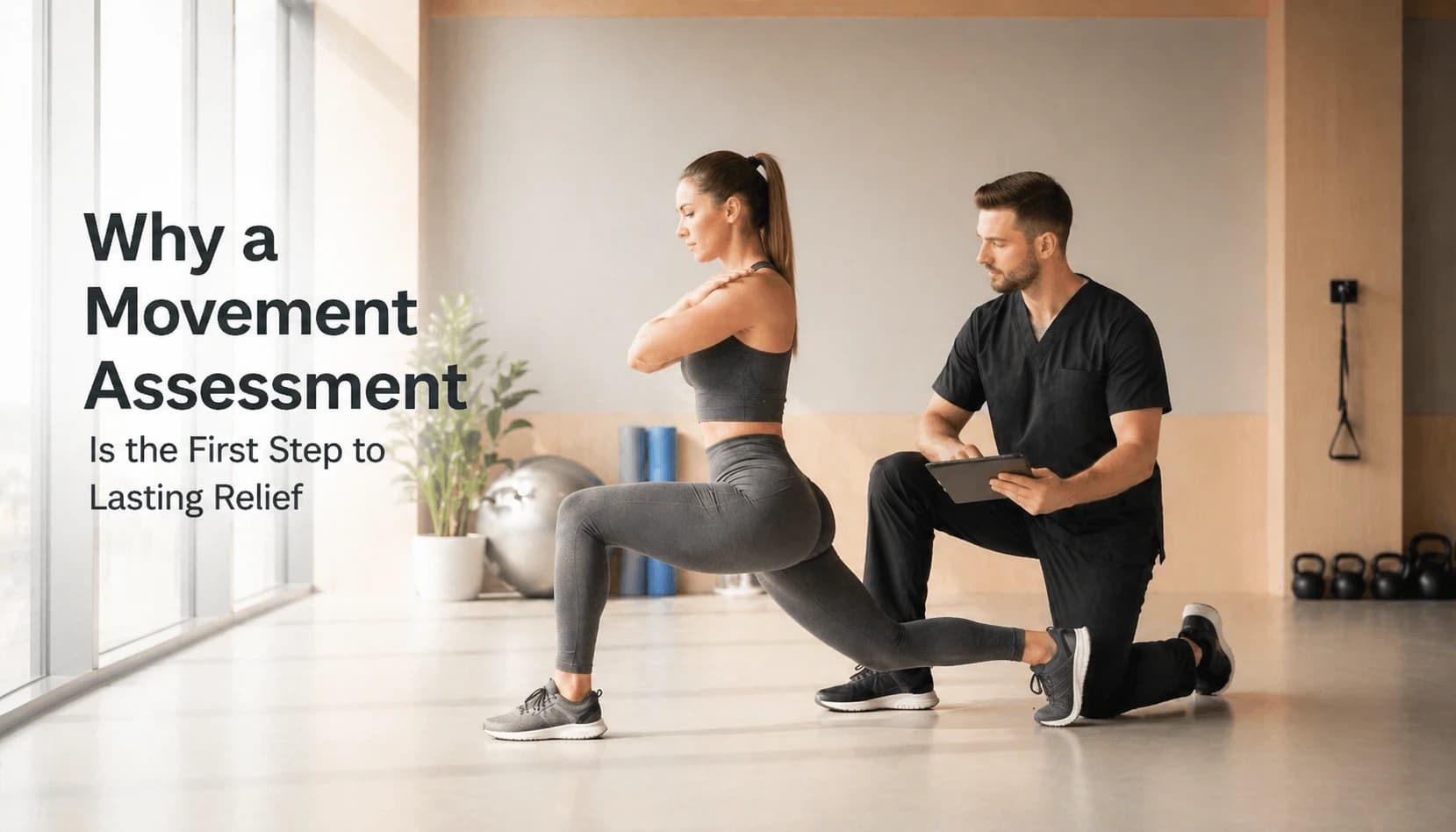
At Move Muscle & Joint in Overland Park, we start differently. We begin with a comprehensive movement assessment that reveals exactly how your body is (and isn't) moving.
This assessment shows us:
- Where your mobility is restricted
- Where your stability is compromised
- Which movement patterns have become dysfunctional
- How these issues are contributing to your pain
Armed with this information, we apply an integrated approach that combines multiple modalities:
Chiropractic restores proper joint mechanics and removes restrictions that prevent normal movement. But it's never the only tool.
Myofascial release therapy addresses the soft tissue restrictions that limit movement quality and feed compensation patterns.
Targeted rehabilitation retrains your body to move correctly and builds the strength and motor control needed to maintain those improvements.
The result? You don't just feel better. Your movement actually improves. Your body works more efficiently. And — this is crucial — you're less likely to have the problem return.
Why Active Adults in Leawood Choose This Approach
Let me tell you what we hear from active adults in Leawood regularly:
"I've been going to chiropractors for years and always needed maintenance care. Since coming here, I've actually gotten better — not just temporarily, but actually better."
"I thought I'd have to give up running. Now I'm training harder than ever."
"I finally understand why I was having the problem. And I know what to do to prevent it from coming back."
These aren't accidental results. They happen because we're addressing dysfunction, not just symptoms.
Real Results for Real Activity
Consider a typical scenario: a 45-year-old from Leawood who plays competitive pickleball and lifts weights. He comes in with shoulder pain that's gotten progressively worse over the past three months. He's already been to two other chiropractors.
During his movement assessment, we identify:
- Limited thoracic spine rotation (his upper back is too stiff)
- Reduced shoulder blade mobility (his scapula isn't moving properly)
- Weak serratus anterior and lower trapezius (his shoulder stabilizers are underactive)
- Poor motor control during overhead movements
Now we have the full picture. His shoulder pain isn't a shoulder problem — it's a movement problem.
Our integrated approach addresses all of these factors:
- Manual therapy and soft tissue work to restore thoracic and shoulder mobility
- Chiropractic adjustments to ensure proper joint mechanics
- Targeted exercises to activate his stabilizer muscles
- Movement retraining to establish healthy overhead patterns
In six weeks, his shoulder pain is resolved. More importantly, his movement quality has improved. He's not worried about the pain returning because he understands what he did, what we fixed, and what he's maintaining with his exercise routine.
Prevention: The Real Value Proposition
Here's what separates this approach from traditional chiropractic: prevention.
Most active adults wait until something hurts before seeking care. But if you're exercising regularly and pushing your body, you're creating opportunities for dysfunction to develop. The real advantage of movement-focused chiropractic isn't treating pain — it's preventing it.
Through regular movement assessments and strategic care, we can:
- Identify movement restrictions before they create pain
- Correct compensation patterns before they cause injury
- Build resilience into your movement system so your body can handle your activity level
This is why some active adults in Leawood see us not when they're hurt, but as part of their regular training routine. They know that maintaining movement quality is the best injury insurance policy available.
What Makes This Different From PT or Fitness Coaching
Physical therapy is excellent when you have a diagnosed condition or are recovering from an injury. But many active adults don't have a diagnosis yet — they just have dysfunction and discomfort.
Fitness coaching is great for building strength and capacity. But a good coach can't assess internal joint mechanics or perform manual therapy to restore mobility.
Movement-focused chiropractic fills the gap. We combine assessment, manual therapy, and targeted exercise programming specifically designed to restore optimal movement patterns.
Think of it this way: PT comes after injury. Fitness coaching builds capacity. Movement-focused chiropractic prevents injury and optimizes the system so you can tolerate higher training loads without breaking down.
The Integrated Approach in Practice
Our method for active adults typically follows this progression:
Week 1-2: Assessment and Initial Treatment
- Comprehensive movement assessment
- Identification of specific dysfunctions
- Initial manual therapy and chiropractic care to reduce pain and restore mobility
Week 3-6: Active Rehabilitation Phase
- Continued manual therapy as needed
- Progressive exercise programming targeting specific deficits
- Movement retraining for functional patterns
- Education on training modifications
Week 7+: Maintenance and Prevention
- Transition to maintenance frequency (usually monthly)
- Continued home exercise program to maintain gains
- Periodic re-assessment to catch new issues early
The timeline varies based on complexity, but the principle remains: we're not managing your pain — we're eliminating the dysfunction that's causing it.
Why Dr. Hugunin's Approach Matters for Leawood Athletes
Dr. Joseph Hugunin has spent years working with elite athletes as a former team chiropractor for Sporting Kansas City and care provider for University of Kansas Athletics. He understands the demands on active bodies.
More importantly, he understands that traditional approaches don't work for people who need to perform. Athletes can't afford to be in maintenance care. They need to get better and stay better so they can do what they love at a high level.
This experience with elite athletes directly informs how we care for active adults in Leawood. The principles are the same whether you're a professional athlete or a 50-year-old who refuses to let fitness fade with age: understand the movement system, address dysfunction, and build resilience.
Common Concerns We Address
"Won't this take a long time?"
Many active adults worry that addressing dysfunction will sideline them for weeks. Actually, the opposite is true. By addressing root causes rather than just managing pain, most people recover faster than they would with traditional approaches. Plus, you're back to full activity with confidence that the issue won't return.
"Don't I need imaging or diagnosis first?"
Not always. A comprehensive movement assessment often reveals exactly what we need to know. Imaging sometimes confirms findings, but dysfunction often shows up in movement long before it shows up on X-ray or MRI.
"Can I keep training while getting treated?"
Yes. In fact, continuing appropriate activity is usually part of the plan. We don't tell active adults to stop. We help them move better so they can train smart.
"Will I need ongoing maintenance?"
Unlike traditional chiropractic, the goal here is to resolve issues, not create dependency on care. Many people transition to occasional check-ups once their movement quality is restored and they're maintaining it with proper exercise.
The Path Forward
If you're an active adult in Leawood or the surrounding areas dealing with recurring pain, limited mobility, or performance issues, you have a choice:
You can continue cycling through chiropractors, physical therapists, and massage therapists, hoping someone will finally fix the problem.
Or you can get a comprehensive assessment of how your body actually moves, identify the specific dysfunction driving your issues, and address it with an integrated approach designed specifically for active people.
The first approach is maintenance. The second approach is improvement.
The active adults in Leawood who've chosen the second path aren't just feeling better. They're moving better. They're training harder. They're confident their pain won't return.
Ready to Move Better?
Stop accepting "that's just how it is" as an answer. Your body is capable of moving better than it does right now. Book your movement assessment with Dr. Joseph Hugunin and discover what's actually holding you back — then watch what happens when you address the real problem.
Your best training is still ahead of you.

About the Author
Dr. Joseph Hugunin
Founder of Move Muscle & Joint and movement-focused chiropractor in Overland Park with 20+ years of experience. Former team chiropractor for Sporting Kansas City and University of Kansas Athletics, with additional experience providing care at UFC events and for touring artists through Live Nation.
Related Articles

Areas We Serve
Move Muscle & Joint provides chiropractic care, myofascial release therapy, shockwave therapy, and targeted rehab to patients throughout the Kansas City metro area.
Located at 10701 El Monte St, Studio 2, Overland Park, KS 66211. Call +1-913-303-0989 to schedule.