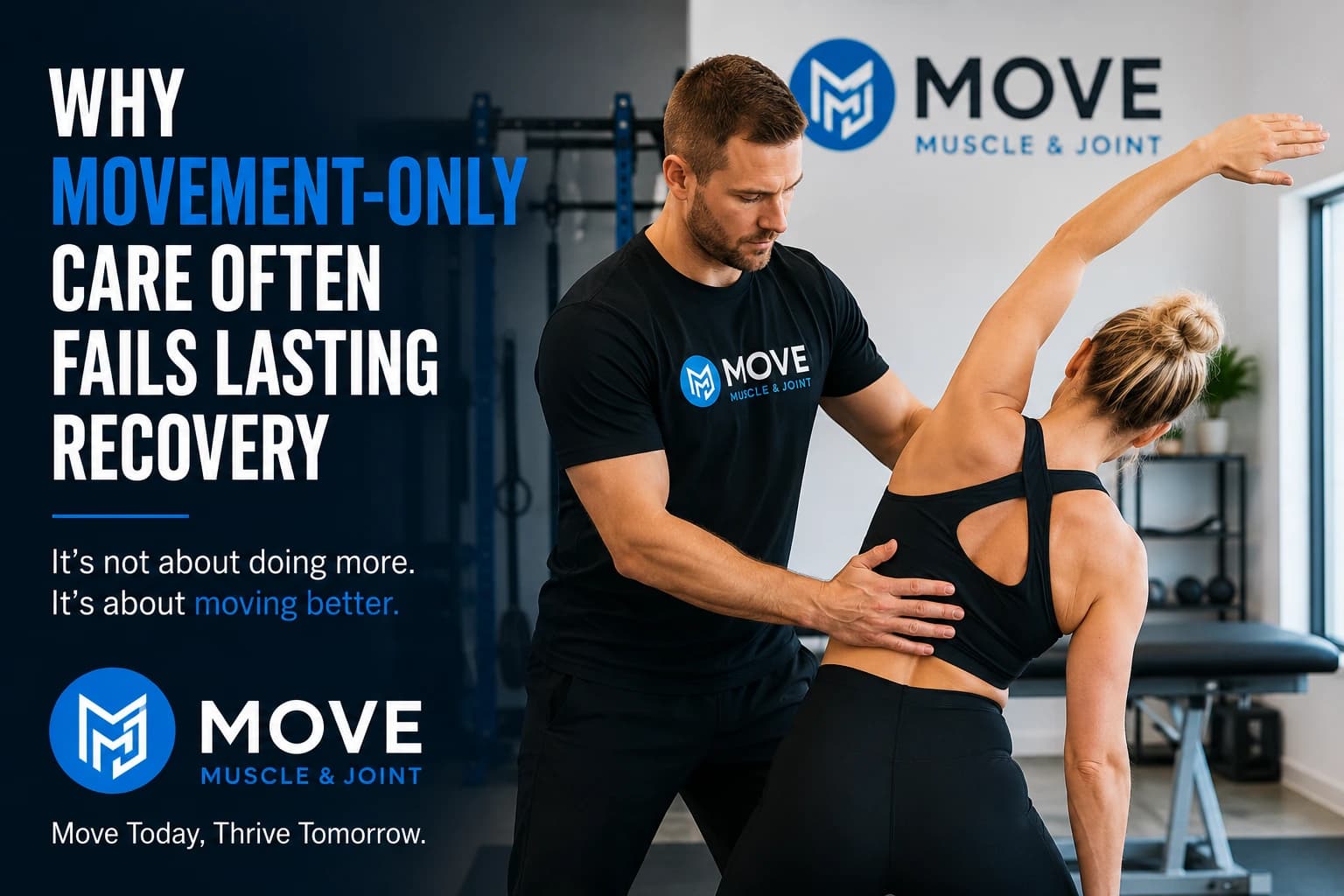
If you've ever stretched more, exercised harder, or followed a rehab program consistently — yet still felt pain return — you're not alone. One of the biggest misconceptions in modern musculoskeletal care is the idea that movement alone fixes everything.
Exercise matters. Strength matters. Mobility matters. But if the body is moving around dysfunction instead of through healthy mechanics, you often end up reinforcing the very compensation patterns causing the issue in the first place. This is exactly why understanding your movement patterns is so critical to real recovery.
The Problem With Isolated Treatment Approaches
Many treatment models focus on just one piece of the puzzle:
- Adjustments without retraining movement
- Rehab exercises without restoring joint mechanics
- Stretching without improving stability
- Strength training without addressing compensation patterns
- Pain management without identifying the root cause
The body is a connected system. If one area loses mobility, another area compensates. If one muscle group becomes inhibited, another overworks. Over time, those adaptations become your "normal" movement pattern.
That's why someone can:
- Strength train consistently and still have back pain (even with the right daily habits)
- Stretch daily and still feel stiff
- Rest repeatedly and never fully recover
- Keep re-injuring the same shoulder, knee, or hip
Pain is often the final output of dysfunction that has existed long before symptoms appeared. When you understand how pain develops, you understand why symptom management alone falls short. For example, someone with recurring sciatica might see temporary relief from stretches or treatment, only to have symptoms flare again because the root cause was never addressed.
Why Temporary Relief Keeps Happening
Many people get stuck in cycles like this:
- Pain flares up
- They rest or get temporary treatment
- Symptoms improve briefly
- They return to activity
- Pain comes back again
The issue is that symptom reduction is not the same thing as movement restoration. This is why a thorough movement assessment is so important at the beginning of your recovery journey — it identifies the underlying dysfunction before we address symptoms.
If the pelvis still rotates poorly, if the rib cage does not move correctly, if the ankle lacks mobility, or if the nervous system still perceives instability — the body will continue finding ways to compensate. That compensation may temporarily avoid pain, but it usually increases long-term stress elsewhere. For runners, this might mean knee pain from poor hip stability. For desk workers, it often manifests as chronic low back issues — which is why movement prevention strategies matter so much.
The Move Method™ Approach
At Move Muscle & Joint in Overland Park, our approach combines:
- Chiropractic care
- Myofascial release therapy
- Shockwave therapy
- Targeted rehab and movement retraining
Instead of separating passive treatment from active recovery, we integrate them together. This is fundamentally different from movement-only approaches or treatment-only approaches. Everything we do serves one purpose: to restore how you move.
Our goal is not simply to reduce pain. Our goal is to restore efficient movement patterns — which is why every patient starts with a detailed movement assessment.
That means helping patients:
- Improve joint mechanics
- Reduce compensation patterns
- Restore tissue quality
- Build stability in the right places
- Relearn movement under load
- Return to life and training with confidence
For example, patients dealing with sciatica don't just get exercises — we combine those targeted exercises with manual therapy to address nerve compression and tissue quality simultaneously.
The Five Pillars of the Move Method™
- Reduce Pain — Address acute symptoms so you can begin moving (this is where treatment like chiropractic care, myofascial release, and shockwave therapy makes an impact)
- Restore Alignment — Correct joint mechanics and positioning (identified during your initial movement assessment)
- Relearn Movement — Retrain your nervous system for healthy patterns (where targeted exercises like those for sciatica become essential)
- Build Strength — Develop capacity and resilience (incorporating core work similar to the daily habits that prevent back pain)
- Move With Confidence — Return to activities you love, pain-free
Why Education Matters
Real recovery usually requires understanding how multiple systems interact together:
- Joint mechanics
- Soft tissue quality
- Nervous system response
- Breathing mechanics
- Stability and control
- Load tolerance
- Movement strategy
The better a patient understands their own body, the better long-term outcomes tend to become. When you understand why something hurts and how your body is compensating, you become empowered to make better decisions about your recovery. This is exactly what happens during a comprehensive movement assessment — you learn how your specific body organizes movement and where the breakdowns are occurring. Armed with that knowledge, whether you're implementing daily prevention habits or working through rehabilitation for a specific condition like sciatica, you make smarter choices that accelerate your progress.
Movement Is the Goal — Not Endless Treatment
At Move Muscle & Joint, we believe great care should help people become more independent, not more dependent.
That means:
- Fewer flare-ups
- Better resilience
- Improved confidence during movement
- Sustainable home strategies (like the daily habits that prevent back pain)
- Smarter training decisions
- Long-term physical capacity
Whether you're dealing with chronic tightness, recurring injuries, lifting limitations, desk-related pain, or sports performance issues, the answer is rarely found in a single isolated intervention. The body adapts as a system. Recovery should work the same way. Someone dealing with sciatica doesn't just need targeted exercises — they need to understand why the nerve became irritated in the first place, which requires understanding their movement patterns.
Ready to Experience Integrated Movement-Based Care?
If you're tired of short-term fixes and want a more integrated approach to recovery and performance, our team at Move Muscle & Joint helps patients throughout Overland Park and the greater Kansas City area move with more confidence again.
We combine chiropractic care, myofascial release therapy, shockwave therapy, and targeted rehab to help identify the root cause of dysfunction — not just chase symptoms. This integrated approach works whether you're managing chronic low back pain, recovering from sciatica, or simply wanting to move better and prevent injuries before they happen.
Schedule your movement assessment and discover how the Move Method™ can help you achieve lasting recovery.
Move Today, Thrive Tomorrow.

About the Author
Dr. Joseph Hugunin
Founder of Move Muscle & Joint and movement-focused chiropractor in Overland Park with 20+ years of experience. Former team chiropractor for Sporting Kansas City and University of Kansas Athletics, with additional experience providing care at UFC events and for touring artists through Live Nation.
Related Articles



Areas We Serve
Move Muscle & Joint provides chiropractic care, myofascial release therapy, shockwave therapy, and targeted rehab to patients throughout the Kansas City metro area.
Located at 10701 El Monte St, Studio 2, Overland Park, KS 66211. Call +1-913-303-0989 to schedule.